

Liquid cooling technologies fall into two primary categories:
- Direct-to-chip cooling
- Immersion cooling
Within these categories, there are five main architectures, each with different performance, efficiency, and deployment characteristics.
In practice, many deployments combine liquid cooling with existing air infrastructure, creating hybrid architectures that balance performance and practicality.
Direct-to-Chip Liquid Cooling (Single-Phase)
Overview
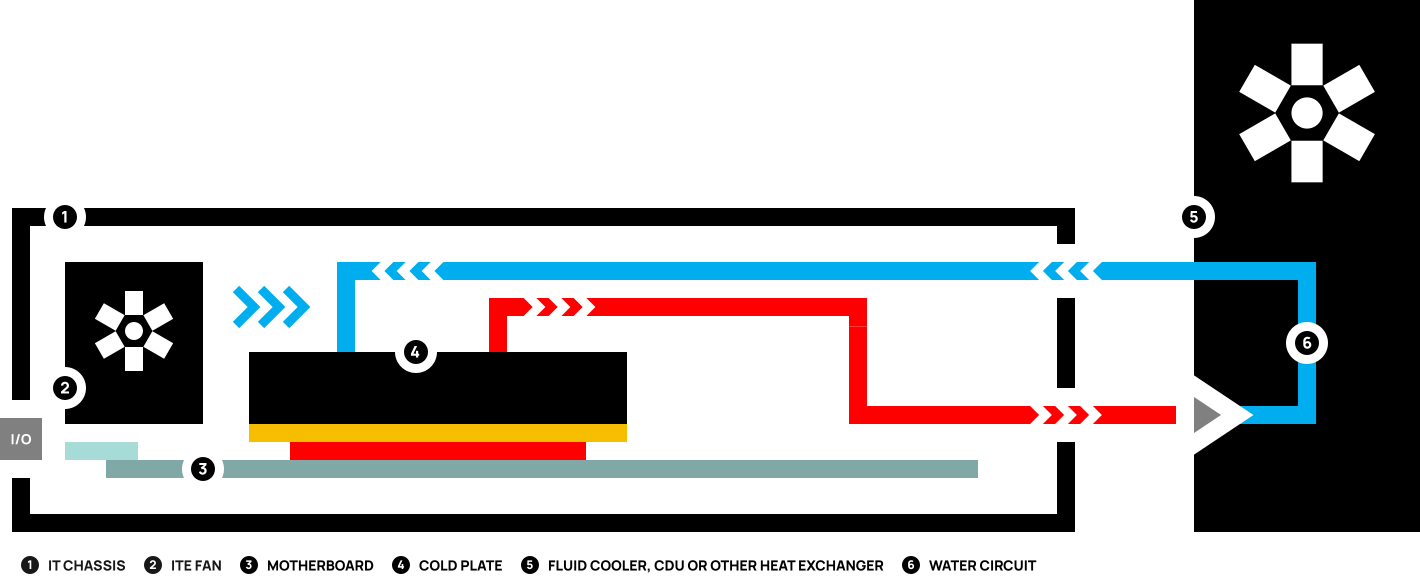
Direct-to-chip liquid cooling (single-phase) delivers coolant directly to the highest heat-generating components – such as CPUs and GPUs – using cold plates. The coolant remains in a liquid state throughout the process, absorbing heat and transferring it away efficiently.
How It Works
Coolant circulates through cold plates mounted on processors, where it absorbs heat at the source. The warmed liquid is then transported through a closed-loop system to a CDU or heat exchanger, where the heat is removed before the cooled liquid is recirculated.
Residual heat from other components is managed using reduced airflow within the server.
Key Characteristics
- Liquid coolant remains in a single phase (no boiling or phase change)
- Heat is removed directly at the chip level
- Closed-loop system connected to a CDU
- Compatible with standard rack-based server designs
Benefits
- High efficiency heat removal
Targets the highest heat loads directly at the source - Supports high-density compute
Enables significantly higher rack power densities than air cooling - Simplified system design
More straightforward to design, operate, and maintain compared to two-phase systems - Ease of integration
Works with existing data centre infrastructure and server form factors
Considerations
- Some airflow is still required for non-liquid-cooled components
- Requires integration with a CDU and facility cooling loop
- Thermal performance depends on system design and flow management
Best For
- AI and machine learning workloads
- High-performance computing (HPC)
- Retrofit and hybrid cooling environments
- Data centres transitioning from air to liquid cooling
Key Takeaway
Direct-to-chip single-phase cooling offers the most practical and widely adopted path to high-density liquid cooling – balancing performance, efficiency, and ease of deployment, particularly in hybrid air + liquid environments.
Direct-to-Chip Liquid Cooling (Two-Phase)
Overview
Direct-to-chip liquid cooling (two-phase) delivers coolant directly to high-heat components such as CPUs and GPUs, but unlike single-phase systems, the coolant undergoes a phase change – boiling into vapor as it absorbs heat.
This phase change enables highly efficient heat removal at very high power densities.
How It Works
A refrigerant is circulated to cold plates mounted on processors. As the fluid absorbs heat, it vaporizes at the chip surface, removing large amounts of thermal energy.
The vapor is then transported to a condenser or heat exchanger, where it is cooled, condensed back into liquid, and returned to the system in a continuous cycle.

Key Characteristics
- Coolant undergoes phase change (liquid to vapor to liquid)
- Very high heat transfer capability due to latent heat absorption
- Uses engineered refrigerant
- Requires tightly controlled system conditions (pressure, temperature)
Benefits
- Exceptional thermal performance
Removes significantly more heat than single-phase systems - Enables extreme density
Supports next-generation AI and HPC workloads at very high power levels - Efficient heat transfer
Phase change allows large amounts of heat to be removed with relatively low flow rates
Considerations
- More complex system design and control requirements
- Higher cost due to specialized fluids and components
- Requires careful management of pressure, sealing, and condensation
- Less common than single-phase in today’s data centre deployments
Best For
- Ultra-high-density AI workloads
- Advanced HPC environments
- Deployments where maximum thermal performance is required
- Purpose-built or greenfield facilities
Key Takeaway
Two-phase direct-to-chip cooling delivers the highest level of thermal performance, but with increased complexity – making it best suited for specialized, high-density environments where performance outweighs system simplicity.
Immersion Liquid Cooling (Tank, Single-Phase)
Overview
Immersion liquid cooling (tank, single-phase) submerges entire servers or IT hardware directly into a bath of dielectric fluid. The fluid absorbs heat from all components simultaneously, providing highly efficient and uniform cooling.
The coolant remains in a liquid state throughout the process.
How It Works
Servers are placed vertically or horizontally within an open or semi-enclosed tank filled with dielectric fluid. As components generate heat, it is transferred directly into the surrounding liquid.
The warmed fluid is circulated through a heat exchanger, where heat is removed before the cooled liquid is returned to the tank, maintaining a continuous cooling cycle.

Key Characteristics
- IT equipment is fully submerged in dielectric fluid
- Fluid is in direct contact with all components
- Single-phase system (no boiling or vaporization)
- Typically uses open bath or tank-based designs
- No need for server-level fans
Benefits
- Highly efficient heat removal
Direct contact cooling enables strong thermal performance across all components - Uniform temperature distribution
Eliminates hotspots by cooling all components simultaneously - Reduced airflow requirements
Removes the need for internal fans and reduces reliance on air cooling - High-density potential
Supports compact, high-density system configurations
Considerations
- Requires purpose-built infrastructure and tank systems
- Serviceability differs significantly from traditional rack environments
- Handling and maintenance of fluid must be carefully managed
- Integration with standard IT hardware may require modification or validation
Best For
- High-density research-based applications
- Controlled environments designed for immersion
- Deployments prioritizing thermal efficiency over standardization
- Facilities optimized for immersion-based infrastructure
Key Takeaway
Single-phase immersion cooling in a tank-based system delivers efficient, uniform cooling across entire servers – but requires a fundamentally different approach to infrastructure, operations, and serviceability.
Immersion Liquid Cooling (Tank, Two-Phase)
Overview
Immersion liquid cooling (tank, two-phase) fully submerges IT hardware in a dielectric fluid that boils as it absorbs heat. This phase change enables extremely efficient heat removal, making it one of the most thermally effective cooling methods available.
How It Works
IT equipment is submerged in a tank filled with engineered dielectric fluid. As components generate heat, the fluid at their surface boils, converting from liquid to vapor and absorbing large amounts of thermal energy.
The vapor rises and comes into contact with a condensing coil or heat exchanger, where it cools and condenses back into liquid. The liquid then returns to the tank, creating a continuous, passive cooling cycle.

Key Characteristics
- IT hardware is fully submerged in dielectric fluid
- Fluid undergoes phase change (liquid to vapor to liquid)
- Heat is removed through boiling and condensation
- Uses engineered fluids designed for controlled phase change
- Minimal or no mechanical pumping required within the tank
Benefits
- Exceptional thermal efficiency
Phase change enables very high heat transfer capability - Supports extreme densities
Ideal for ultra-high-performance AI and HPC workloads - Uniform cooling across all components
Eliminates hotspots through full immersion - Reduced mechanical complexity at IT level
Little to no need for fans or internal airflow
Considerations
- Requires specialized fluids and containment systems
- More complex system design and thermal control
- Higher cost due to engineered fluids and infrastructure
- Serviceability differs significantly from traditional data centre operations
- Fluid management and environmental considerations must be addressed
Best For
- Ultra-high-density AI and HPC deployments
- Purpose-built or greenfield environments
- Applications requiring maximum thermal performance
- Facilities designed specifically for immersion cooling
Key Takeaway
Two-phase immersion cooling in a tank-based system offers the highest level of thermal performance – but comes with increased complexity, cost, and operational considerations, making it best suited for specialized, high-density deployments.


